Which Mineral Sunscreen Offers Better Protection Against Pigmentation and Prevents Melasma?

Introduction:
When the goal is to help prevent pigmentation while protecting the skin from long-wave UVA and blue light, which type of sunscreen performs better: an all-mineral formula or a hybrid-mineral sunscreen? Hybrid-mineral sunscreens can be formulated in many different ways, typically combining mineral UV filters with organic filters, including newer-generation filters as well as filters commonly used in the US. To compare these approaches, we examined popular representative hybrid-mineral sunscreen formulations and the different UV-filter systems they contain. Because the concentrations of individual filters can vary from one formulation to another, we modelled several variations to determine how these differences could influence long-wave UVA and blue light protection. We then compared these results with a sunscreen containing 25% zinc oxide, using sunscreen optimizers from BASF and DSM to evaluate the different formulations.
Background: What part of sunlight creates pigmentation?
We have known for a long time that sunlight can cause pigmentation in the skin and make melasma worse. What is now better understood is that certain parts of the light spectrum can play a particularly important role in excess pigmentation and melasma development, especially long-wave UVA extending toward visible light, including blue light within the 400 nm to 500 nm range.
UV radiation accounts for approximately 5% of the solar radiation reaching Earth, while the complete visible-light spectrum accounts for approximately 50%. We also now understand that ongoing, low-level exposure to blue light can excite chromophores within the skin, creating pathways that contribute to oxidative damage, pigmentation and the resulting melasma.
“While protecting against UVR is still of the utmost importance, it should not stop at the virtual wavelength of 400 nm…indeed, certain skin chromophores appear to be specifically activated by blue light.” (Schutz, Rolf. 2021).
Studies have also shown that protection from blue-light-induced pigmentation can be particularly important for people of colour, especially those with Fitzpatrick skin types IV to VI. (Mahmoud BH, et al. 2010).
This leads to the question of which specific UV filters provide better protection at the longest UVA wavelengths, from approximately 370 nm to 400 nm, as well as into blue light beyond 400 nm.
The Best UV Filters for Blue Light Protection: Particulate-Grade Filters Zinc Oxide and Methylene Bis-Benzotriazolyl Tetramethylbutylphenol (MBBT)
Zinc oxide provides most of its UV protection through absorption, much like organic or “chemical” UV filters. However, one notable difference is its ability to scatter and reflect a small portion of incoming light. What makes this especially relevant is that this scattering and reflection occurs within the important wavelength range where long-wave UVA transitions toward visible light.
Methylene Bis-Benzotriazolyl Tetramethylbutylphenol (MBBT), known by trade names including Tinosorb M and Parsol MAX, is also a particulate-grade UV filter. Because MBBT is insoluble and exists as relatively large particles, it can also provide a degree of light scattering and reflection within this range.
Among the UV filters available worldwide, zinc oxide and MBBT remain two important options for protection across the longest UVA wavelengths, beginning around 370 nm and extending toward blue light. With hybrid-mineral sunscreens, however, the specific protection profile will depend on the combination and concentration of the mineral and organic UV filters used. Some hybrid-mineral formulations may also contain MBBT, and its concentration can vary, making the overall filter system an important factor when comparing long-wave UVA and blue light protection.
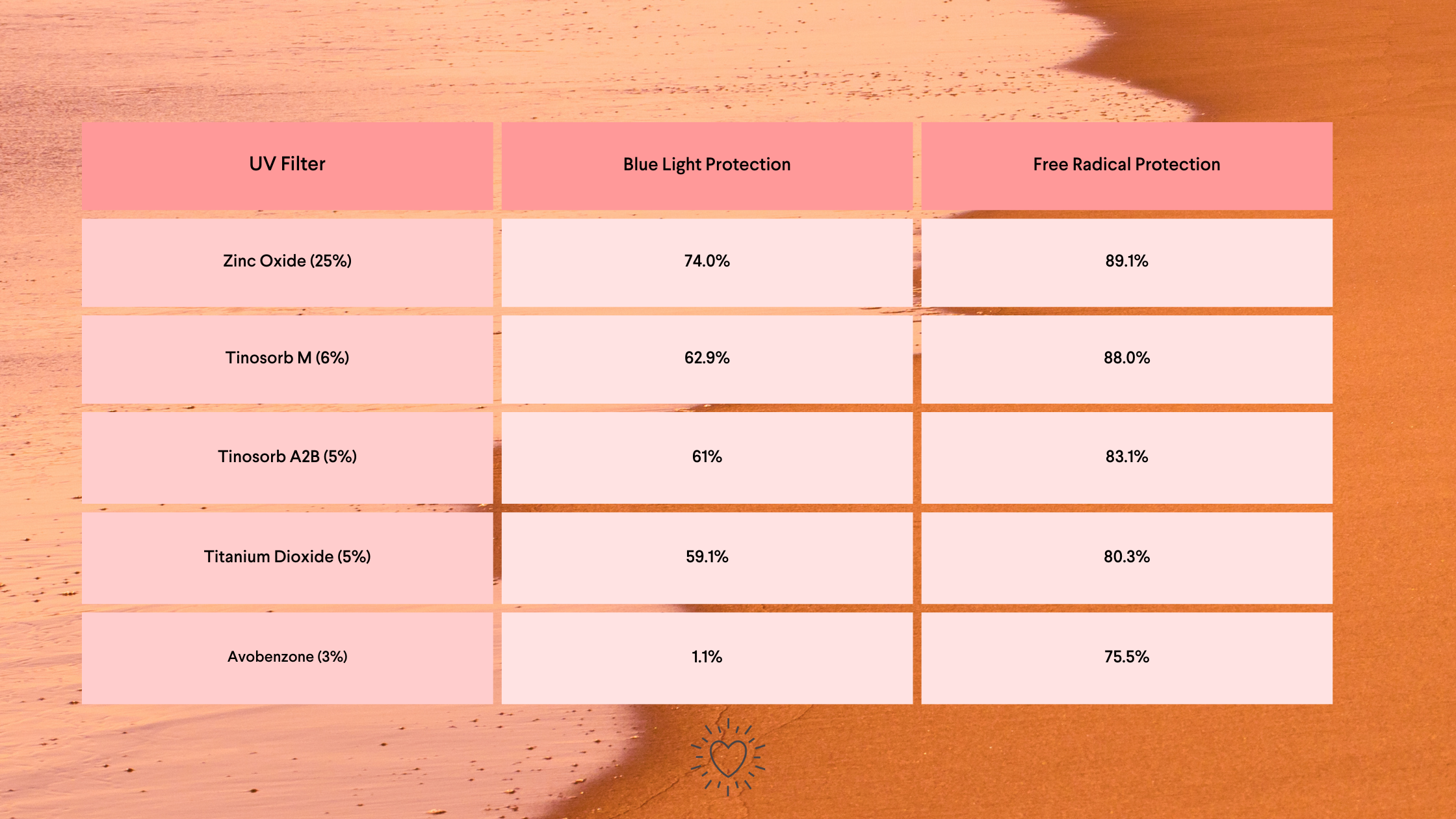
Best UV Filters for Blue Light protection in a sunscreen. Data taken from BASF Solar Simulator. Copyright @TheSunscreenCompany
What’s in Your Sunscreen and the Concentration Used Both Matter
Consumers can sometimes make broad assumptions about the performance of hybrid-mineral sunscreens. Because these formulas may contain newer-generation UV filters and often combine several different filters in one product, it can be easy to assume that they automatically provide complete protection across the UV spectrum. Many consumers may not feel the need to understand exactly which UV filters are present or how much of each one is being used. However, our research indicates that despite the number of UV filters available to sunscreen formulators, only a select few provide meaningful protection at the longest wavelengths of UVA. Our results also indicate that, among the filters examined, zinc oxide and MBBT stand out as the primary options for effective blue light protection and prevention of pigmentation and melasma.
As demonstrated in the table above, Avobenzone performs poorly when it comes to visible light protection. Its UV attenuation also notably drops off at 380 nm, within the long-wave UVA region. BEMT (Tinosorb S and Parsol Shield) does not provide effective blue light protection and does not offer the same quality of protection as MBBT, despite the two sometimes being presented interchangeably.
When it comes to MBBT, the concentration used is particularly important. At concentrations of 1% or lower, MBBT does not come close to providing the same quality of blue light protection. Unfortunately, without disclosure of the individual filter concentrations, consumers cannot determine how much MBBT is present in a particular hybrid-mineral sunscreen.
A sunscreen containing 25% zinc oxide also provides comparable long-wave UVA protection to a sunscreen containing 3-5% MBBT (Tinosorb M, Parsol Max). When MBBT is used at lower concentrations, 25% zinc oxide provides greater long-wave UVA protection. Beyond 400 nm, within the blue light region, zinc oxide outperforms all of the MBBT concentrations evaluated.

Transmission curve showing how much light is let in at each wavelength (the lower the better). Green Curve (1) SPF with .5% MBBT, Light Blue (2) SPF with 1% MBBT, Red Curve (3) with 3% MBBT, Purple Curve (4) with 5% MBBT, Teal Curve (5) SPF with 25% Zinc Oxide
Key Take-Aways:
A sunscreen containing 25% zinc oxide provides the strongest blue light protection of the sunscreen systems evaluated, making it an excellent option for helping prevent pigmentation, melasma, and chronic oxidative stress in the skin.
Where a sunscreen is manufactured does not determine its quality. What matters is which UV filters are included in the formula and the concentrations at which they are used.
Hybrid-mineral sunscreens can incorporate a wide range of UV filters, but having access to numerous filters does not mean every formulation uses them, or uses them at the appropriate concentration. A formula may contain several different UV filters, while typically only one may provide meaningful long-wave UVA and blue light protection, if any.
The concentration of each UV filter is important, and consumers cannot determine exactly how much of an individual filter is present unless the sunscreen brand discloses that information.
When used at the correct concentrations, zinc oxide and MBBT remain the two strongest options for long-wave UVA and blue light protection among the UV filters evaluated, even when considering the broader range of UV filters approved globally.
Avobenzone and BEMT offer little to no protection against blue light.
For optimal long-wave UVA protection, MBBT should be present at concentrations higher than 3%. Below 3%, long-wave UVA protection is compromised and blue light protection is greatly reduced.
As a thank you for reading our blog, we would like to offer you a 10% off discount on any of our suncare and skincare products likein our online store. Click the link below and use promo code SKINBLOG10 at checkout for our exclusive blog discount.
References:
Schulz R. Blue light and skin. In: Surber C, Osterwalder U, editors. Challenges in Sun Protection. Current Problems in Dermatology. Basel: Karger; 2021. Vol. 55, p. 354-373.
Mahmoud, bh,Ruvulo E, et al. Impact of longwavelength UVA and visible light on melanocompetent skin. J Invest Dermatology. 2010; 130 (8):2092-7. dot 10.1038/jjd.2010.95
